
Table of Contents
- Start With Freshness: Why Your Coffee Beans Matter
- The Best Water-to-Coffee Ratio for Your Brew
- Grind Size Explained: How to Choose the Right Consistency
- Water Temperature and Quality: The Hidden Variables
- Step-by-Step Brewing Methods That Work
- Coffee Brewing Troubleshooting: Fix Bitter, Weak, or Sour Tastes
- Why Extraction and Agitation Matter More Than Gear
- Frequently Asked Questions
- Last Updated: October 2, 2026
Start With Freshness: Why Your Coffee Beans Matter
To brew better coffee at home, start with fresh beans, it's the first rule and the most important one. Everything else, your grind size, water temperature, brewing method, matters far less if your coffee has been sitting on a shelf for six months.

Fresh coffee tastes cleaner, brighter, and smoother. Stale coffee tastes flat, bitter, or muddy no matter what you do to it.
When you buy coffee, look for a roasted-on date, not an expiration date. That tells you exactly how fresh it is.
At Bad Habit Collective, we roast to order and ship within 24 hours.
Store your beans in an airtight container away from light, heat, and moisture. A kitchen cabinet works fine.
The Best Water-to-Coffee Ratio for Your Brew
The standard ratio is one to two tablespoons of coffee per six ounces of water.
The easiest way to nail this is with a kitchen scale.
Consistency matters because once you find a ratio that tastes good, you want to repeat it every time.
A basic digital scale is the single cheapest upgrade you can make to your brewing setup and will improve your coffee more than anything else you buy.
Grind Size Explained: How to Choose the Right Consistency
Grind size controls how fast water extracts flavor from the coffee. Finer grinds expose more surface area, so water pulls out flavor faster. Coarser grinds expose less surface area, so extraction takes longer.
The key is matching your grind size to your brewing method. Use the wrong grind size and you either under-extract (weak, sour coffee) or over-extract (bitter, harsh coffee).
Coarse Grind for Immersion Brewing
Coarse grind looks like breadcrumbs or sea salt. Use it for French press and cold brew, where the coffee sits in water for several minutes. The long contact time allows proper extraction even with a coarse grind, preventing over-extraction during that soak.
Fine grind in a French press produces bitter, over-extracted coffee because the water has too much time to pull out harsh compounds.
Medium and Medium-Fine for Pour-Over
Medium grind (like sand) works for pour-over methods like Chemex or V60, where water passes through in two to four minutes. If your pour-over tastes sour or weak, go slightly finer. If it tastes bitter, go slightly coarser.
Fine Grind for Espresso and Moka Pots
Fine grind (like powdered sugar) works for espresso machines and Moka pots, where water passes through in seconds. If your espresso tastes weak or sour, your grind is too coarse. If it tastes bitter or chokes the machine, it's too fine.
Water Temperature and Quality: The Hidden Variables
Coffee extracts best between 195 and 205 degrees Fahrenheit. Let boiling water cool for thirty seconds and you're in the right range. You don't need a fancy temperature-controlled kettle.
Filtered water produces cleaner, more balanced coffee than tap water. You don't need expensive equipment, a basic pitcher filter works fine.
Let your water cool slightly before pouring if you're using a pour-over or hand-brewing method.
Step-by-Step Brewing Methods That Work
Pour-Over Brewing
Pour-over is simple, forgiving, and produces clean, bright coffee. You need a dripper (Chemex, V60, Melitta, or similar), a paper or metal filter, and hot water.
- Place your filter in the dripper and rinse with hot water to remove paper dust and warm the equipment.
- Add medium-ground coffee to the filter (use your 1:16 ratio).
- Pour just enough hot water to wet the grounds, about twice the weight of the coffee. This is the bloom. Let it sit for thirty seconds. This allows the coffee to degas and prepares the grounds for extraction.
- Slowly pour the remaining water in a circular motion, keeping the water level consistent. The whole brew should take three to four minutes.
- Once the water has dripped through, remove the dripper and pour your coffee into a cup.
The key to pour-over is pouring slowly and evenly. Rushing the pour under-extracts. Pouring too slowly over-extracts.
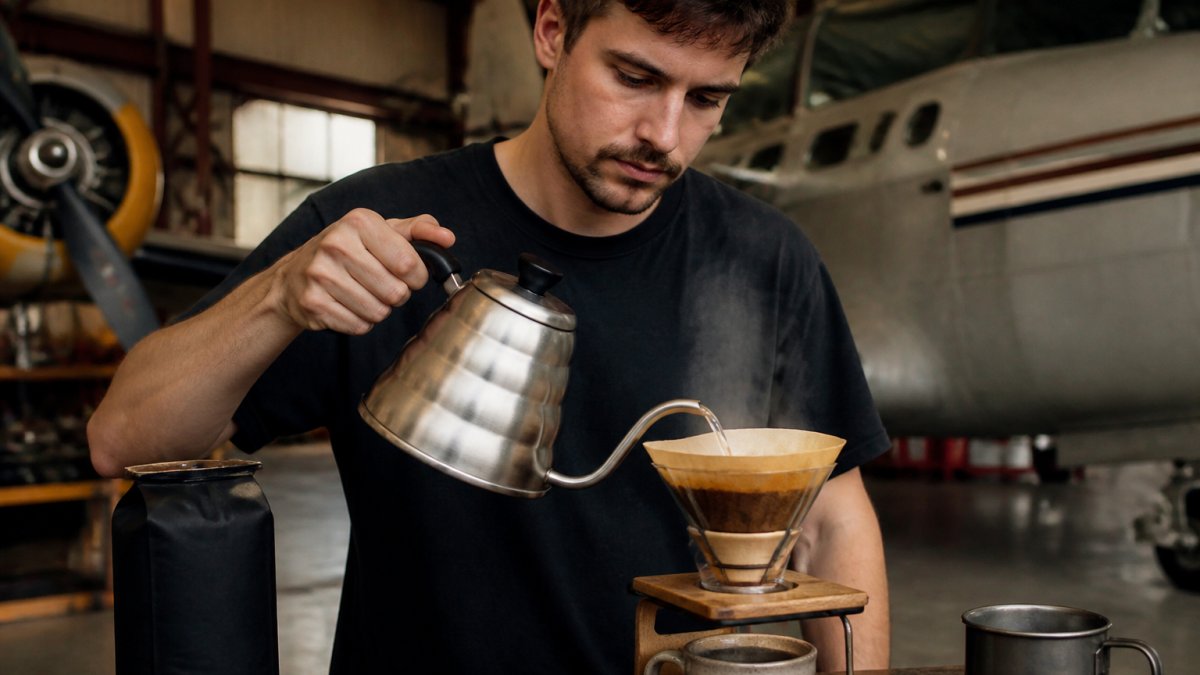
French Press Immersion Brewing
French press makes bold, full-bodied coffee. It's harder to mess up than pour-over, but grind size matters.
Breakfast Blend (Medium Roast) →
- Add coarse-ground coffee to the empty press (use your 1:16 ratio).
- Pour hot water to just cover the grounds and let sit for thirty seconds (the bloom).
- Stir gently to break up the crust of grounds on top.
- Pour the remaining hot water and place the lid on top without pressing down. Let it steep for four minutes.
- Press the plunger down slowly and steadily. This takes about thirty seconds.
- Pour immediately into your cup.
The bloom step is important in French press too. It lets the coffee degas and extracts more evenly. Don't skip it.
French press leaves sediment in your cup, that's normal. Some people like it. If you don't, pour your coffee into another cup, leaving the last bit (with the sediment) in the press.
Automatic Drip Coffee Maker
Drip machines are convenient, but they're only as good as your setup. Use medium-fine ground coffee and follow the 1:16 ratio.
Most drip machines brew at the right temperature if they're in decent condition. The main variable is how long the water sits on the grounds.
Clean your machine regularly. Mineral buildup inside reduces water flow and temperature, which throws off extraction.
Coffee Brewing Troubleshooting: Fix Bitter, Weak, or Sour Tastes
Bitter coffee usually means over-extraction.
Weak or sour coffee usually means under-extraction. The water didn't spend enough time pulling flavor from the grounds.
If your coffee tastes flat or dull, your beans are probably stale. There's no fix for this except fresh coffee.
If your coffee tastes inconsistent, great one day, mediocre the next, your variables are shifting. Use a scale for both coffee and water.
Why Extraction and Agitation Matter More Than Gear
Extraction is the process of pulling soluble compounds out of the coffee grounds.
This is where grind size, water temperature, and brew time all connect.
Agitation helps extraction happen faster and more evenly. In French press, you stir once.
This is why a basic pour-over can produce better coffee than some automatic machines.
Learn to adjust your grind, water temperature, and brew time based on how your coffee tastes.
Our Breakfast Blend brings together specialty-grade coffees roasted for balance and clarity and ships within 24 hours of roasting. It's built for everyday brewing, the kind of coffee that works in a pour-over, a French press, or your regular drip machine. Start with fresh beans, dial in your grind and ratio, and you'll taste the difference immediately. That's the whole game.

Frequently Asked Questions
What is the most effective way to brew coffee at home?
The most effective method depends on your equipment and patience. Pour-over and French press both produce excellent coffee when you control grind size, water temperature (195-205°F), and brew time. The key is consistency: use a burr grinder for uniform grind size, measure your coffee-to-water ratio by weight, and use filtered water. Start with a 1:16 ratio (1 gram coffee to 16 grams water) and adjust to taste. Any method works if you nail extraction.
How much coffee grounds should I use per cup?
Use a 1:16 coffee-to-water ratio by weight as your baseline. That means 1 gram of coffee for every 16 grams of water. For a standard 8-ounce cup, that's roughly 0.5 ounces (14 grams) of coffee to 8 ounces (227 grams) of water. A kitchen scale removes guesswork. If that tastes too weak, try 1:15. Too strong, go 1:17. Consistency matters more than perfection.
Why does my home-brewed coffee taste bitter?
Bitterness usually means over-extraction: your coffee steeped too long or the water was too hot. Check your brew time first, most methods should finish in 4-6 minutes. If you're using an automatic drip maker, the water temperature might exceed 205°F. Also check your grind size; if it's too fine, water extracts too much from the grounds. Freshness matters too, stale beans taste more bitter. Use coffee roasted within 2 weeks.
Does water temperature really change the flavor of my coffee?
Yes. Water between 195-205°F extracts the right amount of flavor and acidity. Cooler water (below 190°F) under-extracts, leaving your coffee sour and thin. Hotter water (above 210°F) over-extracts, bringing out bitterness and harsh flavors. If you're using an electric kettle, let the water cool for 30 seconds after boiling to hit the sweet spot. Temperature precision is one reason pour-over beats automatic drip, you control the heat.
How long does coffee stay fresh after roasting?
Coffee tastes best within 2-4 weeks of the roast date. After roasting, beans release CO2 (degassing) for the first 5-7 days, so brewing immediately after roasting can produce uneven extraction. Wait at least a few days, then use the beans while they're still at their peak. After 4 weeks, oxidation dulls the flavor and acidity fades. Buy smaller quantities more often instead of stockpiling. Check the roast date on the bag, it matters more than the purchase date.
Can I make better coffee without buying expensive equipment?
Yes. A burr grinder and a kitchen scale matter far more than a fancy machine. Those two tools cost less than $50 combined and will improve your coffee more than a $300 espresso machine used with a blade grinder. Beyond that, a simple pour-over cone or French press works as well as anything else. Focus on grind consistency, water temperature, and freshness. Expensive gear doesn't fix bad technique or stale beans.
What is the 15-15-15 coffee rule?
The rule is simple: 15 seconds bloom, 15 seconds pour (or steep), 15 seconds rest. Start by pouring just enough hot water to saturate the grounds and let them bloom for 15 seconds, this releases trapped CO2 and improves extraction. Then pour the rest of your water over 15 seconds, keeping the pour steady. Finally, let the coffee rest for 15 seconds before drinking or serving. It's a beginner-friendly way to control extraction without a timer.