
Table of Contents
- How Long Does Coffee Stay Fresh? The Honest Timeline
- What the Roast Date Actually Tells You
- Coffee Shelf Life After Opening: What Changes Once the Bag Is Cracked
- Why Ground Coffee Fades Faster Than Whole Bean
- The Best Ways to Store Coffee Beans Without Wrecking Them
- What Is Actually Happening Inside the Bag
- Why the One-Way Valve Matters
- A Setup That Actually Works
- The Storage Mistakes That Cost You the Most Flavor
- How to Tell If Coffee Is Stale: A Visual and Sensory Checklist
- Does Freezing Coffee Actually Preserve Freshness?
- Freshness by Brewing Method: Why Your Grind Size Sets the Clock
- Why Small-Batch, Roasted-to-Order Coffee Wins the Freshness Race
- Conclusion: Drink It While It Is Worth Drinking
- Frequently Asked Questions
Last Updated: October 4, 2026
How Long Does Coffee Stay Fresh? The Honest Timeline
Here is the short answer: whole bean coffee stays fresh for about two to four weeks after the roast date. Ground coffee gives you closer to one week.
That window is not a suggestion. At Bad Habit Collective, we roast in small batches and ship within 24 hours for exactly this reason.
Below, we will break down the real timeline, how to tell when your coffee has gone stale, and how to store it so you get every good cup you paid for.
| Coffee Type | Peak Freshness | Still Decent | Past Its Prime |
|---|---|---|---|
| Whole bean, opened | 2-4 weeks | 4-6 weeks | 6+ weeks |
| Ground coffee, opened | 5-7 days | 1-2 weeks | 2+ weeks |
| Whole bean, sealed | 4-8 weeks | 2-3 months | 3+ months |
| Vacuum sealed | 3-4 months | 6 months | 6+ months |
What the Roast Date Actually Tells You
The roast date is the only date that matters. Not the "best by" stamp. Not the sell-by date. Those are guesses built around shipping schedules, not flavor.
A roast date tells you how long the beans have been resting. Coffee needs a few days to release carbon dioxide in a process called degassing. Brew it too early and it tastes flat and foamy.
So check the bag before you buy. If there is no roast date printed, that is your answer about how serious the roaster is.
Coffee Shelf Life After Opening: What Changes Once the Bag Is Cracked
Once you open the bag, the clock speeds up. Oxygen gets in, aromatic oils start breaking down, and moisture creeps into the beans. This is oxidation, and it is the main reason coffee goes stale.
The shelf life after opening depends on three things: how the coffee is stored, whether it is whole bean or ground, and how often you open the container.
Why Ground Coffee Fades Faster Than Whole Bean
Grinding exposes more surface area to air. More surface area means faster oxidation. That is the whole story.
Whole bean coffee has a protective shell. Once you grind it, you have roughly a week of good flavor, sometimes less. This is why we tell people to buy whole bean and grind right before brewing.
If you buy pre-ground because your setup is simple, that is fine. Just buy smaller amounts more often. A basic drip machine still makes a better cup with fresh grounds than with a three-month-old brick.
The Best Ways to Store Coffee Beans Without Wrecking Them
Store coffee in an airtight, opaque container at room temperature, away from light, heat, and moisture. That single habit does more for freshness than any gadget on the market.
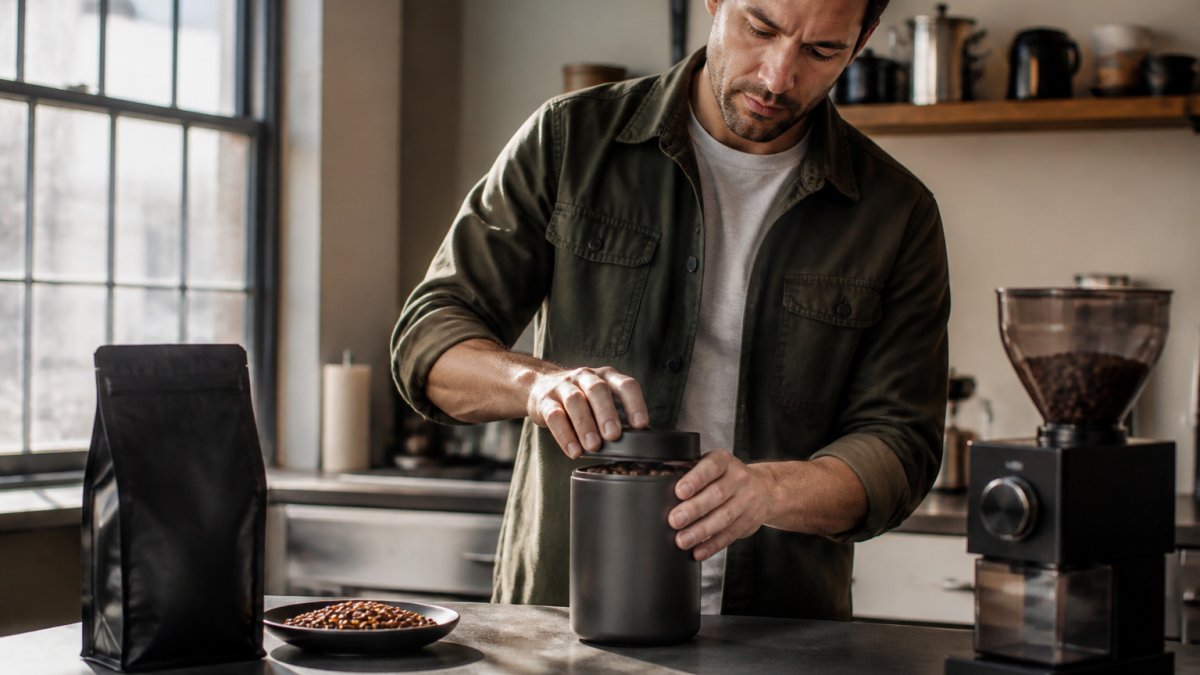
What Is Actually Happening Inside the Bag
Coffee beans are porous and full of aromatic oils. Those oils are what you taste. Three things destroy them, and they all work faster together than they do alone.
- Oxygen reacts with the oils in a process called lipid oxidation. This is the main event. It is the same reaction that turns cooking oil rancid, just slower and more pleasant-smelling in the early stages.
- Moisture speeds up that reaction and also pulls flavor compounds out of the bean. A wet spoon, a humid kitchen, or a fridge full of leftovers all contribute.
- Light breaks down the oils directly. That is why the clear glass jar on the counter looks great and performs poorly.
Heat accelerates all three. So does surface area, which is why ground coffee fades roughly four times faster than whole bean. More exposed surface, more places for oxygen to land.
Why the One-Way Valve Matters
Good coffee bags have a small one-way valve on the front. After roasting, beans release carbon dioxide for several days, this is degassing, and it is why a freshly roasted bag puffs up. The valve lets that gas escape without letting oxygen in.
Here is the practical takeaway: if your bag has a working valve, you can store beans in the bag itself, rolled tight and clipped. If it does not, move them to an airtight container.
A Setup That Actually Works
Here is how we would set it up:
- Keep the beans in the original bag if it has a one-way valve, or move them to an airtight, opaque container.
- Store the container in a cool, dark cabinet, not on top of the fridge and not next to the stove. Both spots run warm.
- Buy only what you will drink in two to three weeks. Freshness is easier to protect than to restore.
- Keep the scoop dry. A wet spoon introduces moisture, and moisture kills flavor.
- Skip the clear glass jar on the counter. It looks good and lets light do its work.
- Do not store beans in the hopper of your grinder for more than a day or two. Hoppers are open to the air and often sit in light.
The Storage Mistakes That Cost You the Most Flavor
Ranked by how much damage they do, the usual offenders look like this. Leaving the bag open on the counter is the worst, because it combines oxygen, light, and whatever the kitchen is doing that day.
The good news is that fixing the first two takes about ten seconds a day. Fresh coffee is not a complicated system. It is a short list of habits, done consistently, by people who actually want to taste what they paid for.
How to Tell If Coffee Is Stale: A Visual and Sensory Checklist
You can spot stale coffee before you brew it if you know what to look for. The beans lose their shine, the aroma fades, and the grounds stop blooming when hot water hits them.
Run through this checklist:
- Smell the beans. Fresh coffee smells sweet and complex. Stale coffee smells like dry hay or nothing at all.
- Look at the surface. Fresh beans have a slight oily sheen. Old beans look matte and dull.
- Check the bloom. Fresh grounds puff up and bubble when you pour hot water on them. Flat grounds mean dead coffee.
- Taste it black. Stale coffee tastes flat, papery, or bitter in a hollow way.
- Squeeze a bean. Fresh beans are hard and snap when you break them. Old beans crumble.
If two or more of those boxes are checked, your coffee is past its peak. It will not make you sick. It just will not taste like much.
Does Freezing Coffee Actually Preserve Freshness?
Yes, if you do it right.
Here is the mechanism. Oxidation, the reaction between oxygen and the oils in the bean, slows down as temperature drops.
The catch is water. Every time you pull a cold bag out into a warm kitchen, moisture condenses on the beans.
Here is how to do it without sabotaging yourself:
- Freeze whole beans, not ground. Ground coffee has already lost its protective shell, and the surface area problem does not get better in the cold.
- Portion before you freeze. Split the bag into amounts you will finish in about a week. Mason jars, vacuum-sealed bags, or heavy freezer bags with the air pressed out all work.
- Squeeze or vacuum out as much air as you can. Oxygen is the enemy; the freezer only slows it down.
- Label each portion with the roast date. You will not remember in six weeks.
- Pull one portion at a time and let it come to room temperature before you open the container. Opening it cold is how you invite condensation onto the beans.
- Never thaw and refreeze. Each cycle adds moisture and accelerates the decline you were trying to prevent.
A few honest trade-offs. Freezing does not improve coffee, it preserves what is already there.
Freshness by Brewing Method: Why Your Grind Size Sets the Clock
Different brewing methods expose coffee to air and water at different rates, so the freshness window shifts a little depending on how you brew.
- Espresso uses a fine grind and high pressure. It shows staleness fast, so use beans within two weeks of the roast date.
- Pour-over and drip use a medium grind. You have a bit more room, roughly three weeks.
- French press uses a coarse grind and a long steep. It is more forgiving, but old coffee still tastes flat.
- Cold brew uses a coarse grind and hours of contact time. It masks some staleness, but fresh beans still make a cleaner, sweeter concentrate.
The pattern is simple. The finer the grind and the faster the brew, the less room you have for old coffee.
Why Small-Batch, Roasted-to-Order Coffee Wins the Freshness Race
Coffee from a grocery shelf is often months old before you open it. Small-batch roasters flip that timeline by roasting to order and shipping fast.
That difference is the entire reason Bad Habit Collective exists. We roast in small batches and ship within 24 hours, so the bag that lands on your porch is days old, not months.
If you drink coffee every day, this matters more than any brewing gadget.
Conclusion: Drink It While It Is Worth Drinking
Coffee is a perishable product, and treating it that way is the difference between a ritual you look forward to and a chore you tolerate. Buy fresh, store it right, and finish the bag while it still has something to say.

If you want coffee that shows up days off the roaster instead of months, start with Bad Habit Collective. We ship within 24 hours of roasting, back every order with a 7-Day Taste Guarantee, and offer free shipping on all coffee plus 15% savings with a subscription.
Frequently Asked Questions
Does coffee actually go bad, or does it just lose flavor?
It mostly loses flavor, but it can go bad. Dry coffee does not grow mold or bacteria the way wet food does, so an old bag will not usually make you sick. What happens is oxidation: oxygen attacks the aromatic oils and volatile compounds that carry flavor, and the coffee turns flat, papery, and bitter. Past a certain point, usually well beyond a year, the oils can turn rancid, which you will taste immediately. The practical answer is that stale coffee is not dangerous, just disappointing.
How long does ground coffee stay fresh compared to whole beans?
Ground coffee loses peak flavor in a matter of days, while whole beans hold up for about two weeks after the roast date. Grinding exposes far more surface area to oxygen, so the aromatic oils and volatile compounds escape much faster. If you buy pre-ground, keep it in an airtight container away from light and heat and plan to finish it within a week or two. If you want the full window, grind right before you brew.
Does storing coffee in the freezer keep it fresh longer?
Yes, if you do it right. Freezing slows oxidation and degassing, which can stretch shelf life from weeks to months. The catch is moisture and repeated temperature swings. Use a vacuum sealed or truly airtight container, freeze in small portions you will use within a week, and never thaw and refreeze the same beans. Pull the portion out, let it come to room temperature before grinding, and keep the rest sealed.
How do I know the coffee will actually arrive fresh if it is shipped within 24 hours?
Look for a roast date on the bag, not just a best-by date. Bad Habit Collective roasts to order and ships within 24 hours of roasting, so the clock starts when the coffee leaves the roaster, not when it hits a warehouse shelf. Once it lands, transfer the beans to an airtight container, keep them out of light and heat, and you are working with the full two-week peak-flavor window instead of whatever was left after months in distribution.