
Table of Contents
- What Small-Batch Roasting Actually Is
- Fresh Roasted Coffee vs Store Bought: The Real Difference
- Why Small-Batch Roasting Gives Roasters More Control
- How Long to Rest Coffee After Roasting Before You Brew
- How to Store Coffee Beans to Keep Them Fresh
- How to read a roast date and know what you are buying
- What fresh coffee actually smells and tastes like
- How to store beans so they actually last
- The honest limit of storage
- Does Small-Batch Coffee Have More Caffeine?
- Why Small-Batch Coffee Tastes Smoother and Less Bitter
- A practical side-by-side you can run this weekend
- What "smoother" actually means in the cup
- The other levers that decide whether your cup tastes good
- Where BHC fits into this
- Frequently Asked Questions
Last Updated: October 16, 2026
What Small-Batch Roasting Actually Is
Small-batch roasting means roasting in smaller quantities, typically 5 to 50 pounds per batch, rather than the hundreds or thousands of pounds large commercial roasters handle. The roaster controls every variable: temperature, airflow, roast duration, and cooling speed.
Beans are not all the same. Even within a single origin, density, moisture, and size vary. A small-batch roaster adjusts heat in real time, responding to how the beans behave.
At Bad Habit Collective, we roast to order and ship within 24 hours.
Fresh Roasted Coffee vs Store Bought: The Real Difference
The coffee on a grocery store shelf was roasted weeks or months ago, then sat in a bag, a warehouse, a truck, and finally under fluorescent lights.
Fresh roasted coffee tastes different because those compounds are still there.
Store-bought coffee compensates with darker roasts, which taste stronger and can mask staleness.
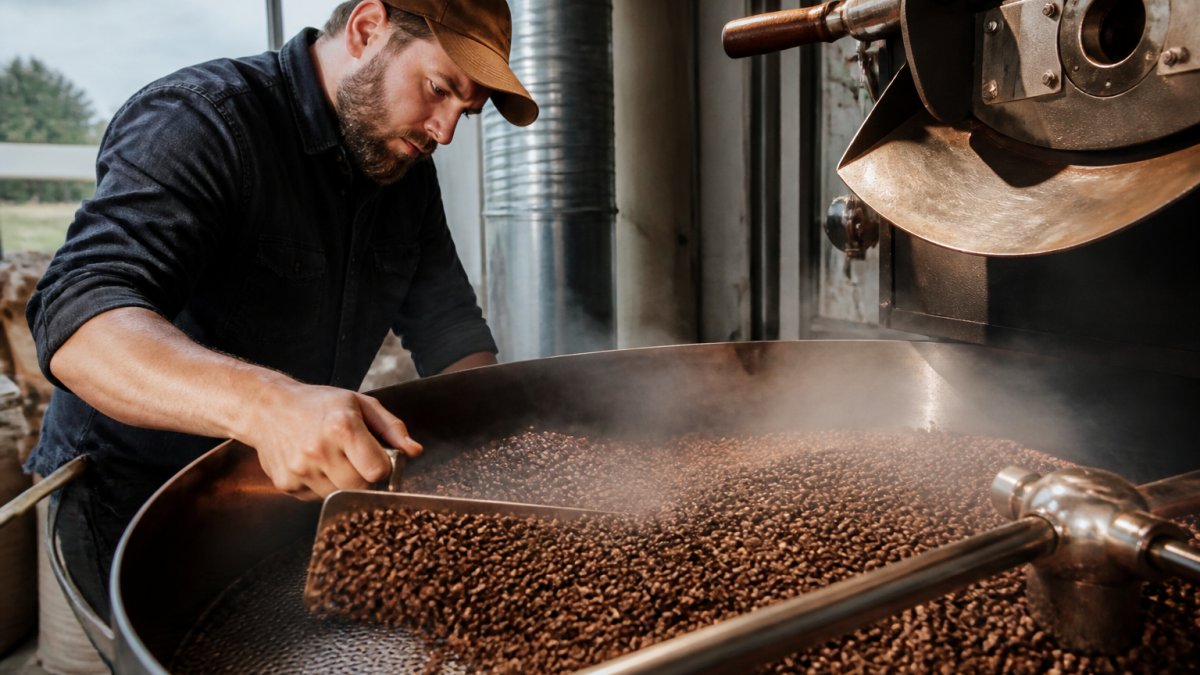
Why Small-Batch Roasting Gives Roasters More Control
A small batch roaster watches the beans.
Large-scale roasting is automated. The roaster loads hundreds of pounds and lets the machine follow a preset program.
This is why consistency is actually harder at scale.
Roast profiles matter here. A roast profile is the temperature curve over time. A small-batch roaster can create different profiles for different beans.
Large-scale roasters use one profile for everything, or maybe two. It works, but you lose the nuance.
How Long to Rest Coffee After Roasting Before You Brew
Coffee needs time to degas after roasting.
Most coffee needs time to degas after roasting before brewing, though some origins hit their sweet spot closer to a week.
Here's where small-batch roasting has a real advantage: coffee can be shipped after it has rested.
That's why we ship within 24 hours. The coffee has rested enough to taste smooth but is still fresh enough to taste bright.
How to Store Coffee Beans to Keep Them Fresh
Freshness is not a vibe. It's a countdown that starts the moment beans leave the roaster, and storage only slows it down. It doesn't stop it.
How to read a roast date and know what you are buying
A roast date is the only date on a coffee bag that matters. A "best by" date tells you when the roaster thinks the coffee will be at its worst. A roast date tells you when the clock started. No roast date?
Here is a rough timeline for coffee freshness:
- Days 0 to 2 after roast: the coffee is degassing hard. Carbon dioxide is pouring out of the beans and pushing water away during brewing. Cups taste sour, thin, and uneven. This is why coffee is often rested before shipping.
- Days 3 to 14: the sweet spot for most coffees. Degassing has slowed enough that water can extract properly, and the aromatic compounds are still intact. This is when you want to be drinking it.
- Days 15 to 30: still good, but the brightness fades first. The acidity gets softer and the aromatics get quieter. Not bad, just less.
- Past 30 days: drinkable, but you are now tasting what is left rather than what was there. Past 60 days, most coffees taste flat and papery no matter how well you stored them.
Lighter roasts tend to hold up a little longer than dark roasts because the oils have not been pushed to the surface as aggressively. Dark roasts oxidize faster once the oils are exposed. That is chemistry, not opinion.
What fresh coffee actually smells and tastes like
You do not need a lab. Your nose and your tongue will tell you.
Open a fresh bag and you should get a clear hit of aroma, fruit, chocolate, nuts, whatever the coffee is supposed to be. If it smells like nothing, cardboard, or a hardware store, it's past its window.
In the cup, fresh coffee tastes layered, you can pick out more than one thing. Stale coffee tastes like one flat note with a dry, papery finish.
How to store beans so they actually last
The enemies are air, light, heat, and moisture, in roughly that order. Here is how to fight them:
- Keep the beans whole until you brew. Grind right before you use them. A burr grinder produces an even particle size, which means even extraction. Uneven grind means some grounds over-extract and some under-extract in the same cup.
- Use an airtight container, not the bag. An airtight container works well. The bag it came in is fine for transport and less ideal for daily use, every time you open it, you dump fresh air onto the beans.
- Store at room temperature, in a dark cabinet. Not the fridge. Not the freezer. Cold surfaces cause condensation when you pull the container out, and moisture is worse for coffee than a few degrees of warmth. If you must freeze coffee long-term, freeze it in a sealed bag you never open until you are ready to use the whole thing, and accept that you are trading some quality for shelf life.
- Buy what you will drink in two to three weeks. A one-pound bag is about right for one daily cup drinker. Buying a five-pound bulk bag to save money is a bad trade if half of it goes stale before you get to it. You are not saving anything if you are drinking worse coffee.
- Keep a small amount in your daily-use container and the rest sealed. Every time you open a container, you exchange the air inside. Less opening means slower staling.
The honest limit of storage
No container, valve, or trick will make month-old coffee taste like week-old coffee. Storage buys time; it doesn't reset the clock. The biggest thing you can do is buy fresh from a roaster who prints roast dates, and drink it inside the window.
That's why we print roast dates and ship within 24 hours of roasting. Not because we invented freshness, but because we'd rather you taste the coffee at its best than wonder what the fuss was about.
Does Small-Batch Coffee Have More Caffeine?
No. Caffeine content is determined by the bean type and the roast level, not the batch size.
Arabica beans have less caffeine than robusta beans.
Batch size doesn't affect caffeine at all. A small-batch roaster and a large-scale roaster produce beans with the same caffeine if they're roasting the same origin at the same roast level.
What changes with small-batch roasting is the flavor and smoothness, not the caffeine content. If you're looking for more caffeine, use more coffee or brew it stronger.
Why Small-Batch Coffee Tastes Smoother and Less Bitter
Bitterness comes from two places: over-extraction and oxidation. Over-extraction happens when hot water pulls too much out of the grounds, too fine a grind, too hot water, too long a contact time. Oxidation happens when roasted coffee sits and the oils and aromatics break down.
Here's the part most articles skip: you can test this yourself. "Tastes better" is a claim until you put two cups side by side. Then it's just Tuesday.
A practical side-by-side you can run this weekend
You need two coffees: one small-batch, fresh-roasted bag with a roast date, and one grocery-store bag of the same or comparable origin. Same grinder, brewer, water, and ratio. Change three variables and you learn nothing.
- Weigh 18 grams of whole-bean coffee for every 300 grams of water. That is roughly a 1:16.5 ratio, and it is a solid starting point for drip or pour-over. A kitchen scale beats a scoop every time, volume measures lie about density.
- Grind to a medium setting, about the texture of table salt, if you are brewing drip or pour-over. If you are using a French press, go coarser, closer to coarse sea salt.
- Heat your water to between 195°F and 205°F. Just off a boil is fine. Boiling water scorches lighter roasts and flattens the cup.
- Brew both coffees back to back, same method, same timing. Pour-over: about 3 minutes total. French press: 4 minutes steep, then press and pour.
- Taste them warm, not hot. Let each cup sit for two or three minutes. Very hot coffee numbs your palate and hides the differences you are trying to find.
- Write down what you taste. Sweetness, acidity, body, finish. Not "good" or "bad", actual words. Chocolate, citrus, stone fruit, toast, cardboard. The stale cup usually shows up as flat, papery, or harsh on the back of the tongue.
People who run this test often find the fresh small-batch cup tastes brighter and cleaner, and the older cup tastes flatter with a rougher finish. That is the oxidation talking. It is not subtle once you are looking for it.
What "smoother" actually means in the cup
Smooth is not a flavor. It's the absence of a few specific problems: no harsh, drying astringency on the finish, no ash or burnt-rubber note from a roast pushed too far, no papery cardboard edge from stale oils.
Small-batch roasting helps on all three fronts, but it doesn't guarantee them. A small-batch roaster can still over-roast a batch, and a small-batch bag can still sit on your counter for six weeks because you forgot about it.
The other levers that decide whether your cup tastes good
If you want to understand why some coffee tastes better than others, look past batch size. Four things matter at least as much:
- Green-bean quality. A roaster cannot roast flavor into a bean that never had it. Origin, altitude, variety, and processing method, washed, natural, honey, set the ceiling. Small-batch roasting lets a roaster hit that ceiling more reliably. It does not raise it.
- Roast execution. Two roasters can take the same green coffee and produce wildly different cups. Drop temperature, development time after first crack, airflow, and cooling speed all change the result. A well-executed large-batch roast beats a sloppy small-batch roast every time.
- Time since roast. This is the one small-batch roasters win on by default, because they can ship within a day or two instead of a month. Freshness is not a flavor, but it protects the flavors that are already there.
- Storage after you open the bag. Air, light, heat, and moisture are the enemies. An airtight container in a cool cabinet keeps coffee drinkable for two to three weeks. A bag rolled shut on top of the fridge does not.
Small-batch roasting stacks the deck on numbers two and three. It does nothing for number one, and it cannot save you from number four. That is the honest version of the pitch.
Where BHC fits into this
We roast to order and ship within 24 hours because freshness is the lever we control from our side of the bag. Our Bali Blue is a medium-dark roast with dark chocolate and molasses notes, a controlled roast working a bean with body to spare. Our Costa Rica is a brighter, high-elevation coffee where clarity and acidity are the point. Brew them side by side with a store bag and you'll taste the difference in about thirty seconds. That's the test.


Frequently Asked Questions
What does small-batch coffee mean?
Small-batch coffee is roasted in smaller quantities, usually 5 to 25 pounds per batch, rather than 100+ pounds at once. This means the roaster can adjust temperature and timing for each specific batch instead of using a one-size-fits-all approach. The result is more control over flavor development, better consistency within the batch, and coffee that tastes noticeably different from large-scale commercial roasting.
Is small-batch coffee fresher than store-bought coffee?
Yes, when roasted to order and shipped quickly. Store-bought coffee sits in warehouses and on shelves for weeks or months before you brew it. Small-batch roasters like Bad Habit Collective roast and ship within 24 hours, meaning the coffee reaches you at peak freshness. The flavor and aroma are noticeably brighter, and you avoid the stale, flat taste that comes with age.
How long after roasting should coffee rest before brewing?
After roasting, the beans release excess carbon dioxide, which can make the brew taste sour or muddy. A few days of rest allows the gases to settle and the flavors to stabilize. For the best taste, drink coffee within a few weeks of the roast date.
Does small-batch coffee have more caffeine?
No. Caffeine content depends on the bean origin and how long you brew it, not on batch size. A dark roast has slightly less caffeine than a light roast because heat breaks down some caffeine molecules, but the difference is minimal. Small-batch roasting doesn't add or remove caffeine, it just lets the roaster develop the flavor profile more precisely, so you taste the coffee's actual character instead of bitterness or sourness.